Description
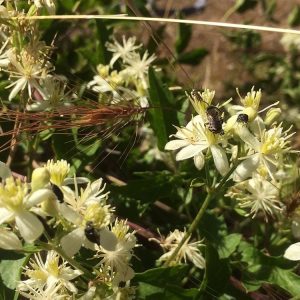
California greenbrier is an unassuming, yet very interesting woody, evergreen, native vine with circular to heart-shaped green leaves. It often has sharp, bristle-like spines on its green stems, and it has black, round fruit with reddish seeds. The small, drooping clusters of green flowers bloom in spring to early summer, depending on elevation. The flowers are not particularly showy, but they are important to a wide range of small pollinators.
Although California greenbrier is a common and important species along streams and rivers in riparian habitat throughout its range, it is often overlooked. It can be found growing in valley-bottom riparian habitats, along shady streambanks in woodlands, ponderosa pine, or mixed conifer forests, in upland areas, or near seeps, springs or other moist locations. California greenbrier is native to northern California and soutwestern Oregon. It generally grows below 5,000 ft. in elevation, and often in thickets of vegetation.
California greenbrier will vine its way up into nearby shrubs or trees, but without anything to grow up into, it will sprawl along the ground, or form something of a small shrub on its own. It has short, knotty rhizomes and can spread via the rhizomes, but it also spreads by seed.
This species can grow in full sun, part-shade, or full shade. It prefers medium to moist soil. It may need some shade at low elevations to help get established.
California greenbrier is often found with chewed up leaves, indicating that the species is used by some insect larvae as a larval host plant.
California greenbrier (Smilax californica) seed packets contain approximately 35 seeds per packet.
Seed Germination Information
Seed germination protocol information for California greenbrier (Smilax californica) is unavailable — it doesn’t appear that any studies on seed germination have been done for this often overlooked species — and this species is new to our collections, so we have not had time to experiment ourselves. We will be growing this species out to text germination strategies. Since this species has a hard seed coat, it may need some sort of scarification or hot water treatment to break the seed coat and allow the seed to imbibe water to germinate. It also may need additional cold-moist stratification. (If you have experience germinating this species, let us know!)